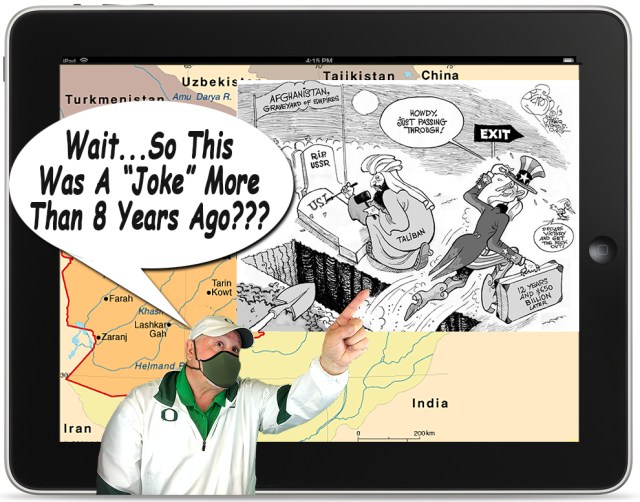
Watching the horrendous chaos that is taking place in Afghanistan, it’s easy to sprint into finger pointing about “what went wrong” in our drawdown and removal of troops from this embattled region where “Empires Go to Die.” This is not a “Biden failure.” Bush got us there, Obama kept us there, Trump capitulated through failed “deal making” with the Taliban, and Biden is simply throwing in the towel, long after our fighters were knocked out.
The history of failures by nations with the “good intentions” of helping the Afghan people to be “free from tribal and extremist rule” goes back centuries. The recently updated WIKI history of the region makes it clear that this isn’t a remotely new outcome. “Some of the invaders in the history of Afghanistan include the Maurya Empire, the Greek Empire of Alexander the Great of Macedon, Rashidun Caliphate, the Mongol Empire led by Genghis Khan, the Timurid Empire of Timur, the Mughal Empire, various Persian Empires, the Sikh Empire, the British Empire, the Soviet Union, and most recently a coalition force of the North Atlantic Treaty Organization (NATO) troops, the majority from the United States, which entered the country in the first-ever invocation of NATO’s Article 5 “an attack on one is an attack on all” following the September 11 attacks in the United States. A reduced number of NATO troops remained in the country in support of the government under the U.S.–Afghanistan Strategic Partnership Agreement. Since American withdrawal in 2021, the Taliban has regained control of the capital Kabul and most of the country. Afghanistan official name changed to Islamic Emirate of Afghanistan”
Holyfreakinshirt!
But if you look at the full history, it becomes clear that the reasons for failure are the same, because the tactics used by all, have a predictable outcome. In short, “Conversion through Invasion and Occupation” is a recipe for failure.
What is the real solution? And more so, does the current failure point to the need for a drastic change in United States and greater world policy?
I think so.
Continue reading →



 CrankyOldGuy.com